

Adding SASS/SCSS to your React/NextJS Application

I'm a UI/UX Designer and Full stack developer based in India. I'm currently a CSE undergrad at Cochin University of Science and Technology.
What is SASS?
SASS short for Syntactically Awesome StyleSheet (Yes, as the name suggests, it's really awesome), it is just CSS but better (Basically you can say SASS is CSS on steroids!). It is a preprocessor scripting language that is interpreted or compiled into Cascading Style Sheets
Why SASS?
SASS has few options which aren't offered by CSS. Few of them are
Variables: With SASS, you can save information in variables to be used again later. So it’s possible, for example, to centrally store a colour value under a catchier variable.
** Mathematical functions:** In SASS, you can also use mathematical operations like +, -, *, /, or %. This allows you to influence size specifications.
Functions: Other functions also make it easier to work on the design. These allow you to modify colour values or analyze lists, among other things.
Mixins: Mixins, simply said, are templates. You can either create them yourself or simply integrate them into your own code when using a framework.
There are many more amazing features offered by Sass.
Syntax
Sass includes two syntax options:
SCSS (Sassy CSS): Using the
.scssfile extension and is fully adjective with CSS syntaxIndented (simply called ‘Sass’): using
.sassfile extension and indentation rather than brackets; it is not fully adjective with CSS syntax, but it’s quicker to write.
Adding it to your React Application
Adding it to CRA app and NextJS app is a bit different, I will explain how you can add it to both the applications.
Adding SASS/SCSS to NextJS Application
It is a straightforward process, you just have to install the sass package and you are good to go!
// using npm
npm i sass

// using yarn
yarn add sass
Adding SASS/SCSS to CRA Application
React-scripts uses sass-loader v8, which prefers node-sass to sass (which has some syntax not supported by node-sass). So we would be using that package instead
// using npm
npm i node-sass@4.14

// using yarn
yarn add node-sass@4.14
Version 4.14 is preferred over the latest version of node-sass because it would throw an error. Or you could refer the below image and install the node-sass version according to your Node version!
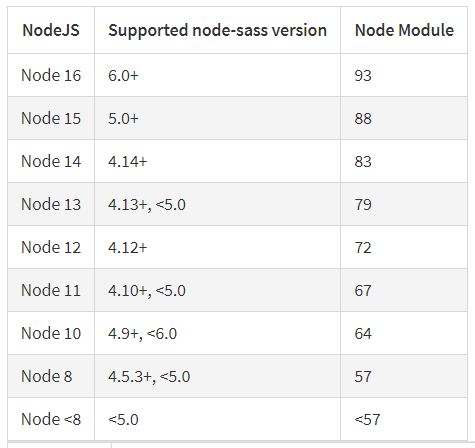
After installing the node-sass/sass package now you just have to rename the .css file extension to sass or scss and change the imports, that's it! You have added the sass/scss to your react application.
I hope this blog post helped you guys.
🙌 Support
If you're enjoying my articles, consider supporting me with a coffee ☕️. It really helps me a lot.
🌎 Lets connect
🎸 Feedback
Feedback helps to improve my articles. I'd love to hear feedback and thoughts on the article. Looking forward to your views.


